


I stood there watching them.
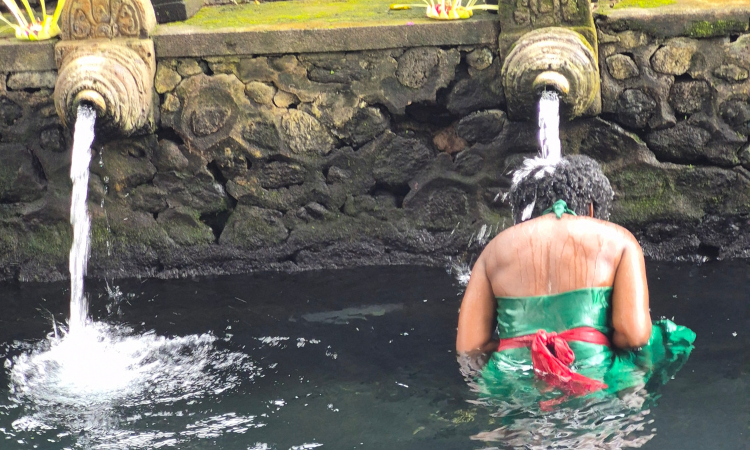
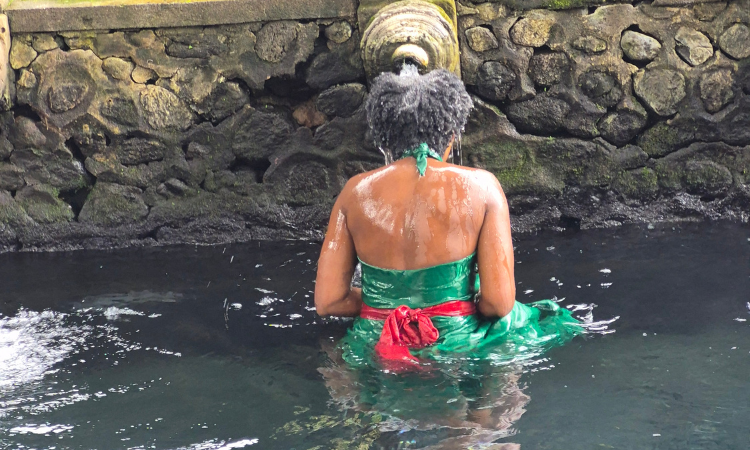
Green sarongs wrapped neatly around their bodies.
Red cloth tied firmly at the waist.
Incense rising into humid air.
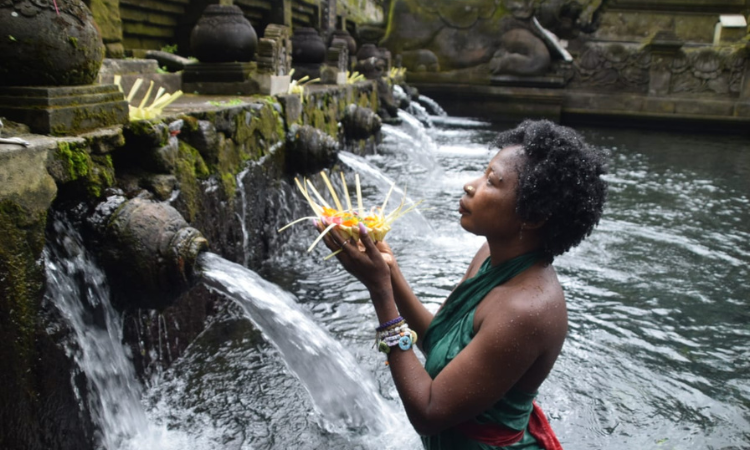
Offerings floating gently on water.
And I asked myself a question that I know will make some people uncomfortable:
Can a Christian step into this water without betraying their faith?
The Moment at the Temple
If you’ve ever visited Bali, you’ve likely seen or heard of the sacred water temples like Tirta Empul Temple.
Visitors dress in sarongs and participate in the Tirta Empul water purification ritual, moving from fountain to fountain and allowing holy spring water to flow over their heads in prayer and reflection.
It is deeply spiritual.
It is deeply cultural.
It is not a performance.
And that is what made me pause.
As a Christian woman African, grounded in Scripture, raised with very clear teachings about idolatry I felt the tension.
Was participation respect?
Or was it compromise?
Water Belongs to Whom?
As Christians, we believe in one God.
But we also believe God created:
The rivers
The oceans
The mountains
The rain
Scripture reminds us:
“The earth is the Lord’s, and everything in it.” Psalm 24:1
If that is true, then water itself belongs to God.
When Jesus was baptized, it was in a river. Water, in Christianity, symbolizes renewal, cleansing, rebirth.
So, if water is God’s creation can it belong exclusively to one religious expression?
At the same time, Scripture is clear:
“You shall have no other gods before me.” Exodus 20:3
So, the question for a Christian visiting Bali is not really about water.
It is about worship.
Is stepping into sacred water automatically worship?
Or can it be an act of cultural humility?
That is where discernment begins.
Faith vs. Fear
Here is where it gets uncomfortable.
Sometimes what we call “conviction” is fear.
Fear of judgment.
Fear of being misunderstood.
Fear of being labelled “lukewarm.”
But is faith so fragile that it cannot encounter another culture without collapsing?
I did not go there seeking another god.
I did not bow in worship to something I do not believe in.
I stood in a space where another community expresses reverence.
And I asked myself honestly:
What is in my heart?
Because when asking, “Is water cleansing in Bali a sin for Christians?” intention matters.
Cultural Participation vs. Spiritual Conversion
There is a difference between:
Observing a ritual
Respectfully participating in a cultural practice
Adopting another belief system
Many travellers experience ceremonies around the world without converting.
The deeper question is not always:
“Is this allowed?”
It is:
What does this mean to me spiritually?
For Christians visiting Tirta Empul Temple, the issue is not tourism it is theology.
As a Black Christian Woman Traveling
This is another layer people rarely talk about.
When you are Black and Christian, there is often an added expectation of spiritual rigidity.
But travel stretches you.
It forces you to encounter other forms of devotion. Other ways of seeing the divine. Other expressions of gratitude and reverence.
And instead of reacting, you reflect.
I am not interested in abandoning my faith.
But I am deeply interested in understanding the world.
And maybe that is where maturity lives.
So, can a Christian do water cleansing in Bali?
There is no universal answer.
Some believers will say no
Some will say it depends on your intention.
Some will say it is cultural appreciation.
For me, the question became less about rules and more about integrity.
If I step into that water, am I betraying God?
Or am I acknowledging that God is bigger than my comfort zone?
Faith is not weakened by exposure.
Sometimes, it is clarified by it.
Let’s Talk
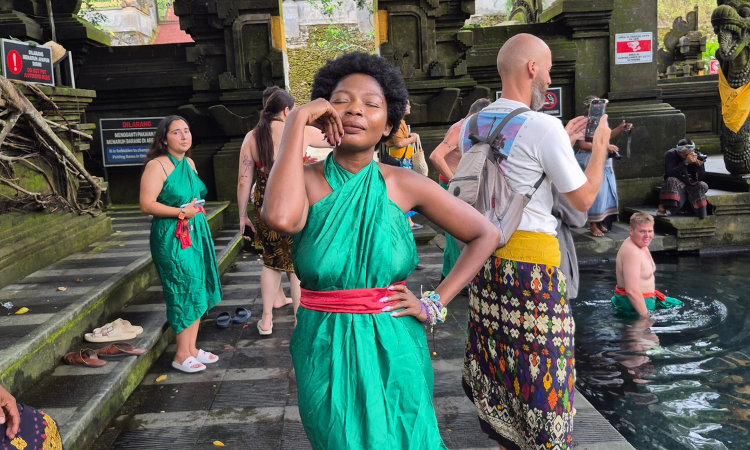
Would you participate in a water cleansing ritual at Tirta Empul Temple in Bali as a Christian?
Why or why not?
I am genuinely curious not combative.
Because growth rarely happens in echo chambers.